History of Religious Congregations and Communities in the Archdiocese
Orders of Priests
Benedictines
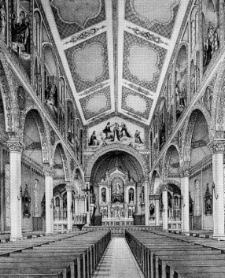
Unique in the annals of the Order of St. Benedict is the growth of a full-fledged Abbey from a simple city parish; such was the beginning of St. Mary’s Abbey, Newark.
Father Nicholas Balleis, O.S.B., a monk from Bavaria who came to this country to work among German immigrants, founded St. Mary’s Church in Newark in 1841. On Sept. 5, 1854, the church was ransacked and destroyed by a mob of Orangemen. Father Balleis saved the Blessed Sacrament at the risk of his life. Father Balleis was succeeded the following year by Father Martin Haslinger, who remained in Newark until returning to Germany two years later.
In that short time much was accomplished. Construction on the Abbey church was started. The cornerstone was laid by Bishop James Roosevelt Bayley on Nov. 1, 1856. The church was dedicated on Dec. 20, 1857. During this time the bishop had been negotiating for a branch of St. Vincent’s Abbey for the Benedictine Order in Newark. In September 1858 Bishop Bayley conveyed to the Benedictines the property belonging to St. Mary’s and entrusted to the monks the care of the congregation.
In 1868 a college was opened to provide a classical education to students from the greater-Newark area. It developed as a preparatory school and today is St. Benedict’s Prep.
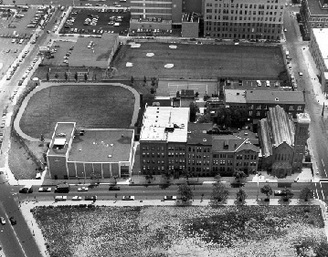
Father Gerard Pilz built the Abbey complex and the monastery. Independent Abbey status was obtained with a Papal Brief on Dec. 19 1884.
Benedictines
Unique in the annals of the Order of St. Benedict is the growth of a full-fledged Abbey from a simple city parish; such was the beginning of St. Mary’s Abbey, Newark.
Father Nicholas Balleis, O.S.B., a monk from Bavaria who came to this country to work among German immigrants, founded St. Mary’s Church in Newark in 1841. On Sept. 5, 1854, the church was ransacked and destroyed by a mob of Orangemen. Father Balleis saved the Blessed Sacrament at the risk of his life. Father Balleis was succeeded the following year by Father Martin Haslinger, who remained in Newark until returning to Germany two years later.
In that short time much was accomplished. Construction on the Abbey church was started. The cornerstone was laid by Bishop James Roosevelt Bayley on Nov. 1, 1856. The church was dedicated on Dec. 20, 1857. During this time the bishop had been negotiating for a branch of St. Vincent’s Abbey for the Benedictine Order in Newark. In September 1858 Bishop Bayley conveyed to the Benedictines the property belonging to St. Mary’s and entrusted to the monks the care of the congregation.
In 1868 a college was opened to provide a classical education to students from the greater-Newark area. It developed as a preparatory school and today is St. Benedict’s Prep.
Father Gerard Pilz built the Abbey complex and the monastery. Independent Abbey status was obtained with a Papal Brief on Dec. 19 1884.
|
|
|
|
Passionists
In 1860 the Passionist Fathers preached their first mission in New Jersey at old St. Mary’s Parish in what was then known as West Hoboken and today is Union City. A year later, St. Mary’s Hall, on the same hill, became the first state foundation where the first pioneer Fathers took care of Our Lady of Mercy Parish.
|
|
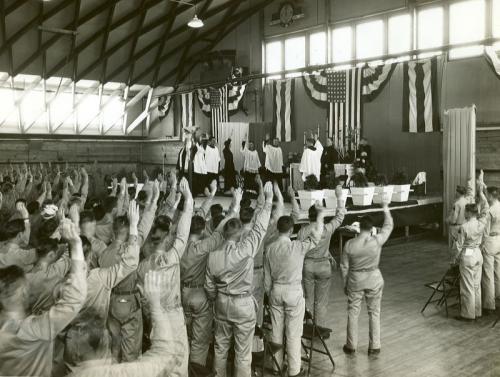
Passionists with soldiers renewing baptismal promises at Ft. Knox St. Michael the Archangel
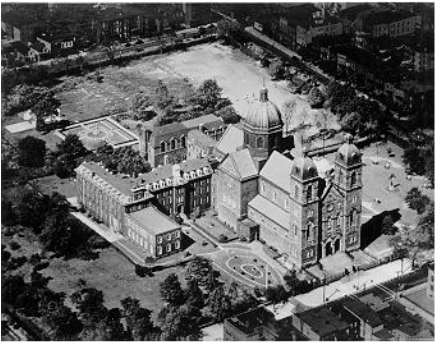
The year 1863 saw the Passionist Monastery of St. Michael the Archangel built on the same site in the Kerrigan Woods section of West Hoboken. A short time later, the first Passionist community began full observations there. The Monastery Church of St. Michael, built in 1857, was destroyed by a fire in 1934. From the ashes arose the new St. Michael’s, with its massive twin towers dominating the Jersey City skyline.
In their early years the Passionists were in charge of St. Mary’s, Bayonne; Immaculate Conception, Montclair; and Sacred Heart, Shadyside. They also founded St. Lawrence Parish, Weehawken, and built and cared for St. Paul’s, Greenville; Holy Family, Union City; and St. Joseph’s, West New York.
The year 1863 saw the Passionist Monastery of St. Michael the Archangel built on the same site in the Kerrigan Woods section of West Hoboken. A short time later, the first Passionist community began full observations there. The Monastery Church of St. Michael, built in 1857, was destroyed by a fire in 1934. From the ashes arose the new St. Michael’s, with its massive twin towers dominating the Jersey City skyline.
In their early years the Passionists were in charge of St. Mary’s, Bayonne; Immaculate Conception, Montclair; and Sacred Heart, Shadyside. They also founded St. Lawrence Parish, Weehawken, and built and cared for St. Paul’s, Greenville; Holy Family, Union City; and St. Joseph’s, West New York.
Jesuits
St. Peter’s, pioneer parish of Jersey City, became the center of the Jesuit Fathers in the Archdiocese. Father Victor Beaudevin, S.J. received the title to the church and school in April of 1871 and became pastor of St. Peter’s. He began the college building in 1877. Classes began the following year. 
St. Antoninus Parish, Newark, was founded in 1875 by the Dominican Fathers. With rapid expansion of the parish, a church was built in 1882, a school seven years later and rectory in 1906. The original school was the victim of a fire on Jan. 30, 1923. The upper portion of the church was completed in 1941.
In 1919 the Dominican Fathers were invited by Bishop John J. O’Connor to take charge of Sacred Heart Parish, Jersey City. 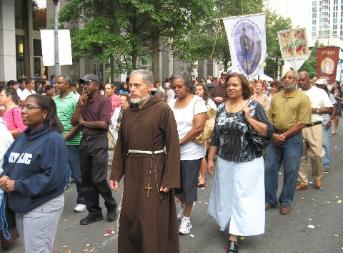
|
Carmelites
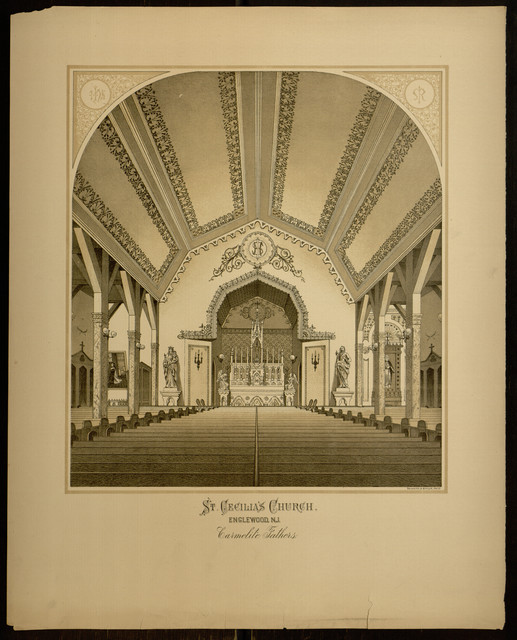
When Father Anastasius J. Smits of the Carmelite Fathers presented himself to Bishop Bayley in 1878, the Diocese of Newark needed priests. The bishop told him he could take over the spiritual care of Bergen County on the condition his order could supply an adequate number of priests. Being unable to do so, Father Smits was appointed to the pastorate of the Church of the Madonna, Fort Lee, and its mission of St. Cecilia, Englewood. 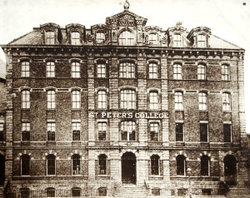
St. Peter's College
Franciscans
The first members of the order Friars Minor Conventual came to Hoboken in 1872. Father Alphonsus Zoeller, O.F.M. founded St. Joseph Parish 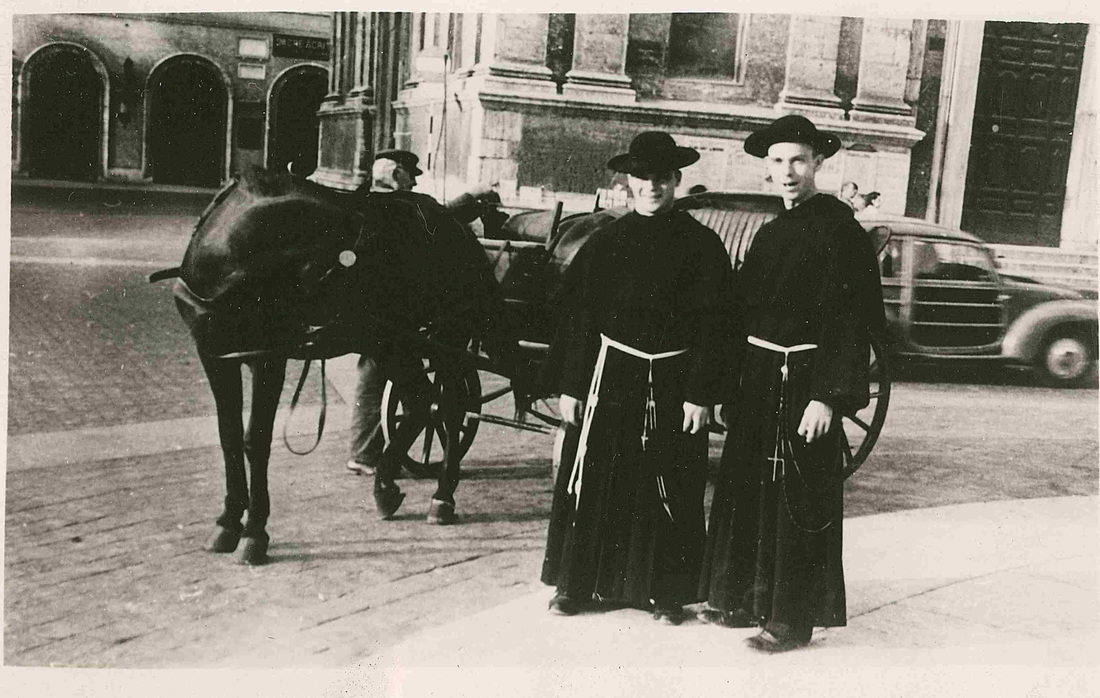
Father Ferdinand Miller, O.F.M. and his small group of Franciscan Fathers came to the Diocese of Newark in August, 1876. From that starting point, the Franciscan Fathers expanded throughout what is now the Archdiocese of Newark.
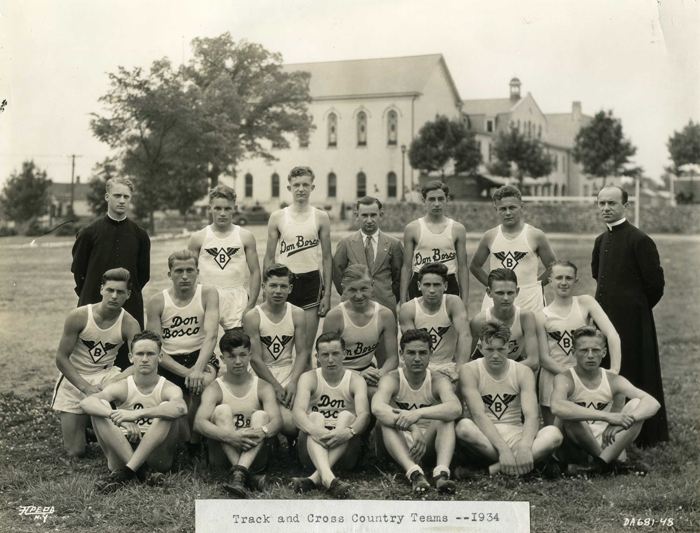
Members of the Society of St. Francis de Sales, known as the Salesians of Don Bosco, opened Don Bosco High School, Ramsey, in 1915.
|
The Capuchin Franciscans began their work
as parish priests and missionaries to Italian immigrants
in the early 1900s.
as parish priests and missionaries to Italian immigrants
in the early 1900s.
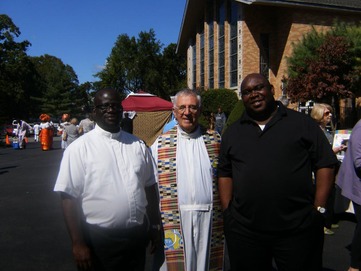
Tenafly in 1921 was where the African Mission Fathers established St. Anthony’s Mission House.
|
|
|
Fathers of the Spanish Province of the Third Order Regular of St. Francis of Assisi arrived in 1926. Their responsibility was the Spanish and Portuguese-speaking population of St. Joseph Parish, Newark.
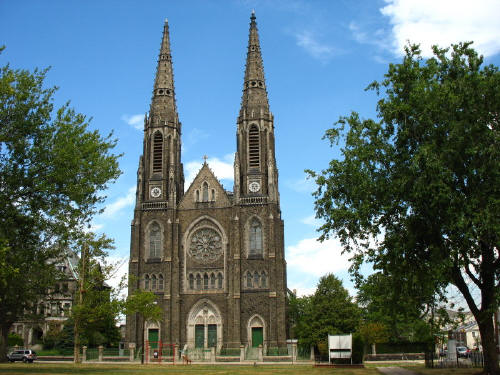
They expanded their mission in 1947 at Immaculate Heart of Mary Parish, Elizabeth
Orders of Brothers
The Brothers of Christian Schools began teaching in the Diocese of Newark in 1866 when they took over the boys department of St. Patrick’s School in the city.
With the mission to nurse and manage hospitals for male patients,
The Brothers of Christian Schools began teaching in the Diocese of Newark in 1866 when they took over the boys department of St. Patrick’s School in the city.
With the mission to nurse and manage hospitals for male patients,
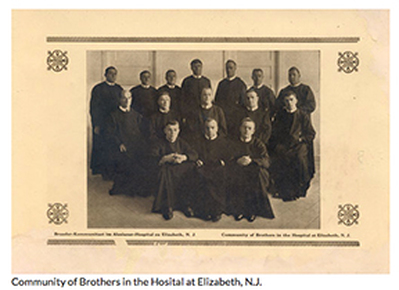
the Alexian Brothers arrived in 1892.
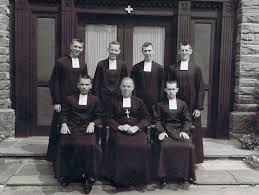
In September of 1954, five Marist Brothers opened Marist High School.
Seated center is Brother Leo Sylvius, first principal.
